A hobby robot can turn a wiring diagram into a moving object on a desk. That change gives young builders a reason to learn code, sensors, motors, and control because each lesson affects what the robot does next.
- Motors turn code into motion
- Small failures teach diagnosis
- Good projects leave room for safer, harder tasks
Learning starts with a machine that moves
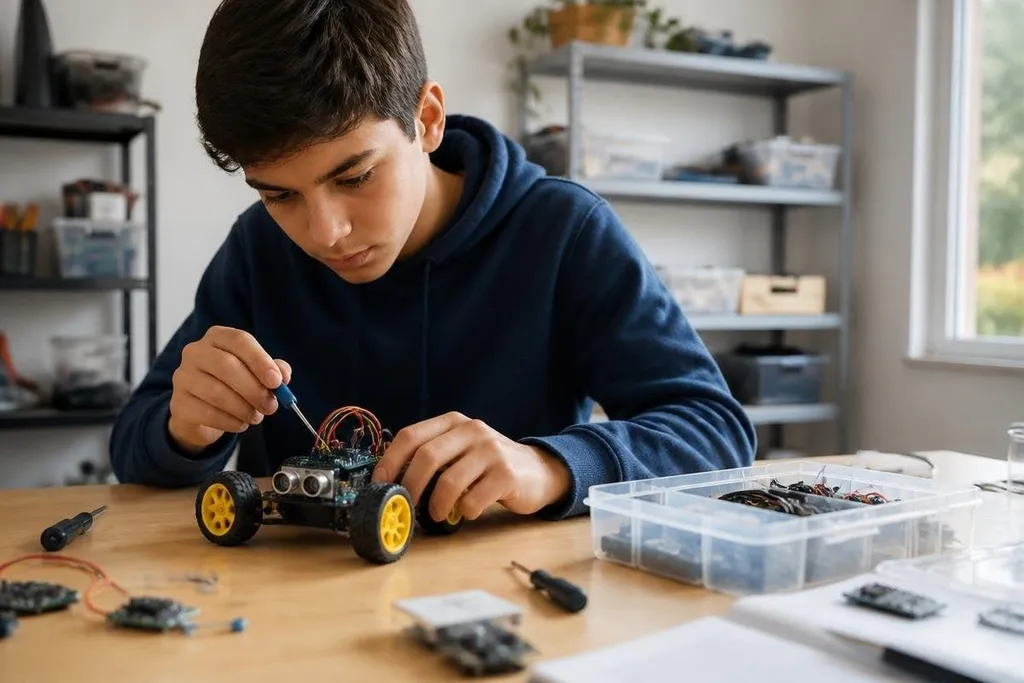
A first robot does not need a complex arm or a large parts kit. A small wheeled robot can follow a line, avoid an object, or move toward a light. Each task links a clear goal to a physical result.
That link matters to a new engineer. A wrong value in the code may send the robot too far, turn it late, or stop it near the wrong place. The builder can see the error, change one part of the program, and run the test again.
This work builds a useful habit: separate the problem into parts. If the robot fails to turn, the builder can check the battery, motor wires, sensor readings, and code in a sensible order. The machine becomes a working lesson in cause and effect.
Failure gives engineering a shape
A hobby robot will often fail in small, safe ways. A wheel may spin at a different speed from the other wheel. A distance sensor may read a nearby table edge as an object. A loose wire may stop the system after several minutes.
Those faults teach a lesson that books cannot carry on their own. The builder has to form a guess, change one condition, and check the result. That process is close to the work used in larger robotics projects, where teams test sensors, motors, software, and safety rules before a machine runs near people.
The robot also shows why measurements matter. A builder can record how far the robot travels, how long a battery runs, or how often a sensor gives the wrong reading. Numbers turn a vague complaint into a problem that someone can work on.
I’d rather see a young builder keep a short test log than chase a polished demo with no record of what failed.
Small projects connect to larger machines
The parts in a hobby robot introduce ideas that appear in factory equipment, research robots, and autonomous systems. A motor needs power and control. A sensor turns part of the physical world into data. Software uses that data to choose an action.
The scale changes, but the questions stay familiar. Can the robot stop when a person enters its path? Does it behave the same way on a clean floor and a rough one? What happens when a sensor stops sending data?
The safety questions on a hobby bench also appear in working systems. Robot 24 reports on machines, companies, and research, giving a builder a way to compare a sensor fault or stop rule with robotics work outside the home. That comparison sets up the next step: adding parts means adding new work around power, code, data, and safety.
A project can grow with the builder. The first version may use a ready-made controller and a basic motor driver. A later version can add a camera, map a room, or send data to a computer. Each added part brings a new job: power planning, code structure, data handling, or safety checks.
What parents and teachers should look for
The price of a kit matters, but the project design matters more. A box that gives one fixed build may hold attention for a short time. A kit with open wiring, readable code, and parts that can be reused gives the builder more ways to ask questions.
Good guidance also leaves room for failure. Adults can ask what the robot did, what the builder expected, and which change should come next. That keeps the focus on evidence instead of guessing.
The strongest projects have a clear task and a limit. A robot might need to reach a marked area while avoiding a block, then stop when its battery voltage falls. The builder learns that a working system must meet its rules every time, not only during one successful run.
A practical checklist for a first project
Use these checks before buying parts or starting the build:
- Choose one visible task, such as following a line or stopping near an object.
- Check that the code, wiring diagram, and parts list are available.
- Leave room to change the sensor position, wheel size, or control rule.
- Add a safe stop method before the robot runs near people or pets.
- Record each test with the change made and the result.
- Plan one harder version after the first task works.
A hobby robot earns its place when it turns curiosity into careful questions. The useful next step is not a larger machine; it is a project where the builder can measure one result, explain one failure, and choose the next test.